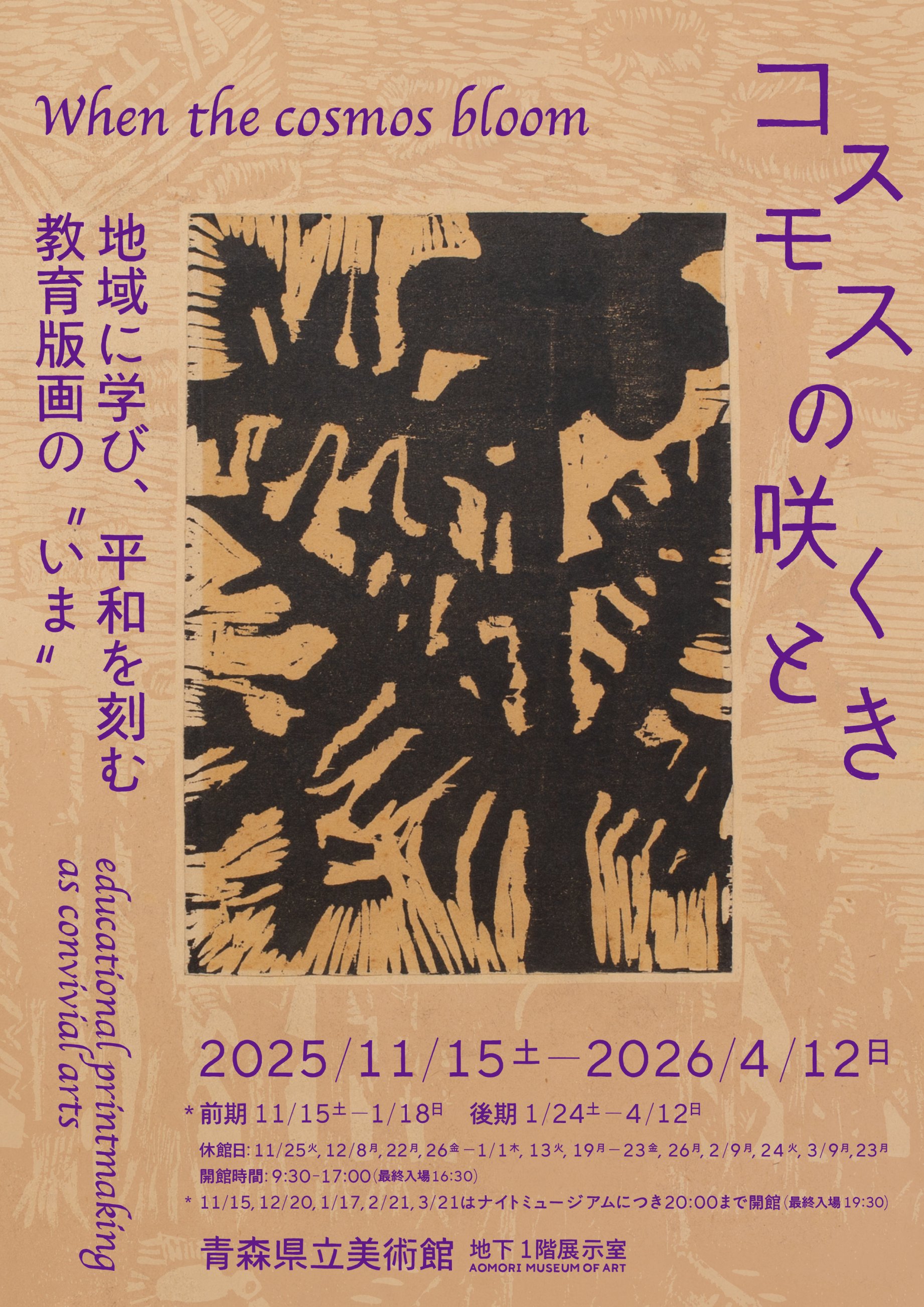
When the Cosmos Bloom: Educational Printmaking as Convivial Arts
“When the Cosmos Bloom” is a prefectural museum exhibit that explores “educational print making” – printmaking within the context of primary and lower secondary education. The project recenters and reiterates the way children learn to coexist with others, while simultaneously reflecting how art can influence and shape contemporary society.
Drawing from the post-war educational printmaking movement led by OTA Koshi (Printmaker, Educator), his and his peers’ work from the pre-war period, as well as from the Suminuri Kyokasho where textbooks were blackened out with sumi ink in the aftermath of the Second World War, this project began as a way to look towards peace. Focusing on educational printmaking materials from the 1950s to the 1990s specific to the prefecture and held in the Goshogawara City Board of Education Repository, the exhibit will be demonstrating the reprinting process for “The History of Shariki Agriculture,” a picture scroll that spans thirty meters in length, displayed alongside woodblock prints created as acts of resistance by the A3BC Anti-War, Anti-Nuclear and Arts of Block-print Collective, creating a space where children beyond borders freely engage with printmaking. It is within this very space that empathy, attentiveness towards one’s local community, and the wish for peace will hopefully take root and resonate.
Even now, 80 years after the war, the world remains scorched by its flames; society and all its contradictions have grown increasingly severe, and the misuse of technology continues to ravage the earth. It is precisely because of this that we today must nurture our hands and our eyes to actively advocate for peace–the flower language of the cosmos. Advocate for learning, advocate for printmaking! Just as the children of the past and the children of today, we too, must grow. Through the works of these children, the hope remains that a cosmos will blossom in the heart of one more person.
Details
Exhibition period
November. 15, 2025 – April. 12, 2026
Venue
M,L,J,I etc.
Admission
Ticket
Adults -700yen(560yen)
College students -400yen(320yen)
Children(High school students and under 18 years old) – Free of charge
Admission is free for disability passbook holders and up to one accompanying adult.
Exhibition Structure
1. How We Choose to Live: Gathering to Resist After the Fact
Have we truly opposed war in all its forms? Have we genuinely desired peace? These are questions that continue to be asked across disciplines, looming over ourselves and the society we inhabit today. This exhibit echoes those questions, seeking answers in the voices of children and through the hands-on act of engraving and printing woodblocks. In the post-war period, textbooks censored with sumi ink forced children to confront and doubt the histories and words they had once believed in. These children grew up, becoming teachers for the next generation, and yet, neither these adults nor children knew what to do. Therein lies the importance of communication. Use your voice. Face the question and fumble for an answer together. What they discovered was the foolishness of war, and the enduring reality of life in its aftermath. This is the backdrop that propels educational printmaking as a social movement. The artists, educators, and the woodblock prints created by children featured in this section represent their act of reclaiming identity, like a light piercing through the sumi ink reaching us here today.
This exhibit includes a variety of pre-war materials and references used by educators, textbooks blackened out with sumi ink, as well as woodblock prints and newsletters that give insight into the post-war education for peace. Through a timeline of the pre-war to post-war period, this display highlights the way educators and children worked together to rebuild a way of living, synergizing their observations of daily life with their prayers for peace.
interlude. Beyond That Mountain: Remembering Hanaoka
2. Learning and Cultivating Ourselves: Reframing the Growth Curve
One of the key topics covered in educational printmaking is “emotion within living.” Through exposure to this topic, children learn to acknowledge each other’s existence, developing an awareness that society is made up of people from all walks of life. As such, this method has increasingly incorporated works that feature local history and topography. By engaging with these works, children are made to understand their roots in the local community, which will in turn, guide their growth far beyond. However, this growth did not follow the kind of curve seen in Japan’s economic boom that swept through society at that time. Instead, it is a steady, grounded growth that uses the realities and hardships of their surroundings as a foundation, cultivating self-discovery through the consideration of others. In short, what educational printmaking seeks to nurture is the humanity of children–something that will be carried forward into the future.
This section showcases works and reference materials from the Japanese Economic Miracle of the 1960s and 1970s that fosters “the other side” of children’s growth where, through learning about local history and events rooted in various parts of the prefecture, they come to be aware of other people. In this first part of the exhibit, alongside the original “The History of Shariki Agriculture” woodblock print and other exhibited works, FUJITA Toshiyuki–who, as a student at Shariki Elementary School up until the 5th grade and then completing 6th grade at Goshogawara Municipal Minami Elementary School, had experience learning with “The History of Shariki Agriculture”–will be reprinting it based on the surviving woodblock. The finished print will be added to the exhibit in the second half. Caught between the past and the present through this educational printmaking relay, what should we, the children of the past and adults of today, pass on to the children who will run after us?
3. The Path of Seeds: Cultivating the Future of Peace and Life Itself
Educational printmaking in the 1970s focused on topics close to children’s immediate surroundings, acting as a guide for day-to-day living. To further strengthen that connection, it also incorporated societal and historical events, as well as stories from the past, which allow children to see themselves within these contexts. The topics learned by these children have been constructed into images that comprehensively express these themes. This mode of expression is referred to as “embodying the cosmos” by one of the leading figures in historical printmaking, SAKAMOTO Shokuro, in his article “Woodblock Prints of the Children of Tohoku” (1995, Shiroi Kuni no Uta (Song from the White Country)). Drawing on the cosmos’ symbolic meanings of “peace” in flower language and its association with the universe, the concept of “peace of the heart and mind” in contemporary times acknowledges that creative works flourish under the overflowing power of imagination. It is precisely because of this cosmos analogy that educational printmaking transcends the boundaries of space and time, bringing us together in solidarity with the children of today.
Displayed in this section are pieces from the 1970s and 1980s that represent the theme of “peace of the heart and mind,” pieces that depict local nature and history, as well as works from artists and children who have been brought together through printmaking. In today’s world where a longing for understanding and unity between humans is keenly felt, nurturing our hands and our eyes could be a practical avenue that will set us on the path towards peace, and reconsidering the role of educational printmaking may be one of the ways forward. Can a cosmos bloom amidst a blowing wind? How and whether it blossoms depends on how we ourselves take on that responsibility.